
LiDAR Data CFD Correction for Wind Resource Assessment
The Challenges
-
→ I don’t know where to position my LiDAR to minimize bias from start
- On complex terrain, a poor placement means biased data throughout, and no post-processing can fully fix that.
-
→ My LiDAR data is terrain-distorted, and I can’t quantify the error
- Flow distortion on hilly or forested site is invisible without CFD modeling.
-
→ I’m not confident my AEP estimate reflects reality
- A miscorrected measurement translates directly into financial uncertainty.
Harness the full potential of LiDARs without compromizing
Our solution
Meteodyn uses CFD modeling to quantify and correct the measurement bias introduced by complex terrain, both to:
STEP 1: Optimize LiDAR positioning before a campaign and,
STEP 2: Correct raw data after it.
Unlike generic correction methods, our approach models the actual airflow over your specific site topography, capturing the distortion patterns that standard processing misses.
- ✓ This method improves accuracy and is validated against meteorological mast data.
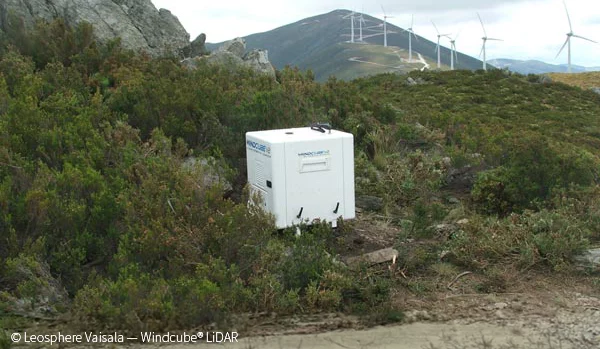
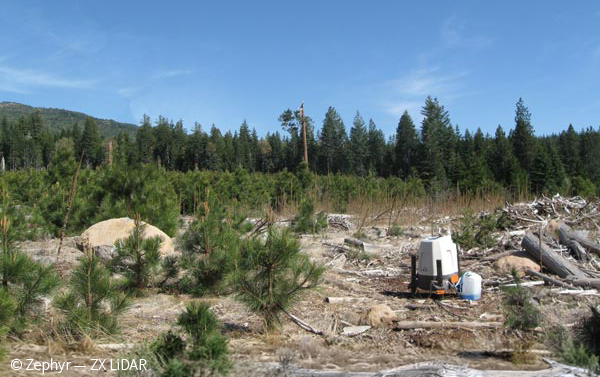
- ✓ LiDAR suppliers: ZX (Zephyr), Windcube (Vaisala), Molas (Movelaser)
Deliverables
- LiDAR wind measurement correction map (Format: PNG, JPEG)
- LiDAR wind measurement correction table (Format: CSV, XLS)
- Corrected wind statistics for AEP calculation
Why Choose LiDAR Data CFD Correction?

Necessary on complex terrains
Remote sensors encounter measurement bias in complex terrain due to the lack of flow homogeneity across the measured volume.

More accurate wind resource assessment
The success of a wind farm project greatly relies on the initial wind resource assessment. A correction of the LiDAR data using CFD simulations is necessary to reduce uncertainty.

Validated technology
Meteodyn’s LiDAR data CFD correction methodology has been validated using met mast data, proving its efficiency in improving the correlation with traditional anemometers.
METEODYN improves LiDAR data accuracy with two solutions, powered by CFD technology
1. LiDAR Positioning Optimization for Wind Measurements on Complex Terrain
Deploying a LiDAR on complex terrain without prior analysis exposes your wind resource assessment to systematic measurement bias. It is a risk that directly impacts energy yield estimates and project bankability.
METEODYN’s LiDAR positioning optimization service uses high-fidelity CFD wind flow simulation to quantify flow inhomogeneity across your site and identify the deployment locations where LiDAR-induced bias is minimized.
The deliverable is a LiDAR wind measurement correction map (PNG, JPEG), a spatially explicit tool that guides optimal instrument placement before your measurement campaign begins.
2. CFD Correction of Measured LiDAR Wind Data
When LiDAR measurements have already been collected on complex terrain, systematic wind speed bias can still be identified and removed through METEODYN’s LiDAR data correction service.
Using CFD simulation to model the full three-dimensional wind field over site topography, METEODYN quantifies the measurement error sector by sector and height by height, producing a LiDAR wind measurement correction table (CSV, XLS) that can be applied directly to your raw dataset.
The corrected time series delivers accurate wind speed distributions, reliable shear profiles, and defensible inputs for energy yield calculations.
FAQ
What is LiDAR wind measurement bias and why does it occur on complex terrain?
LiDAR wind measurement bias refers to a systematic error in wind speed retrieval, where the instrument consistently over- or underestimates the actual wind speed due to unmet physical assumptions.
LiDAR instruments reconstruct wind speed by combining Doppler returns from multiple laser beams, using an assumption of horizontal flow homogeneity within the measurement volume. In complex or mountainous terrain, this assumption is rarely met. On hills, ridgelines, valleys or forested slopes, wind flow is highly three-dimensional, and the instrument returns a systematically distorted wind speed that standard calibration cannot correct.
How significant is the measurement bias on complex terrain?
The complexity of the terrain and the direction of the wind have a significant impact on the bias’ magnitude. According to our several validation campaigns, bias in uncorrected LiDAR data collected during wind measurement campaigns can reach 9% of mean speed values.
The LiDAR mean speed error can be reduced by up to 7% using our Meteodyn LiDAR post correction (CFD Correction of Measured LiDAR Wind Data), resulting in an error of about 1-2%.
It demonstrates why, in the absence of CFD correction, uncorrected LiDAR data over complicated terrain is inappropriate as a stand-alone bankable wind resource input.
What is CFD correction for LiDAR data?
CFD (Computational Fluid Dynamics) correction uses numerical wind flow simulation to model the three-dimensional, inhomogeneous wind field over a site’s topography and surface roughness. CFD models are used offline to predict the effect of the local terrain on the airflow. This calculation is then processed to generate conversion factors that can be applied to LiDAR measurements to remove any bias. These factors, derived sector by sector and height by height, are then applied to the raw LiDAR time series to recover accurate wind speed data.
What are the two CFD correction services offered by Meteodyn?
Meteodyn offers two complementary services depending on the project stage. The first is LiDAR positioning optimization, carried out before a measurement campaign: a CFD-based analysis identifies the site locations where LiDAR-induced bias will be minimal, delivered as a LiDAR wind measurement correction map (PNG, JPEG). The second is LiDAR data correction, applied after measurements have been collected: CFD simulation characterizes and removes the bias from the existing dataset, delivered as a LiDAR wind measurement correction table (CSV, XLS) ready for direct application to the raw time series.
Get started with LiDAR data CFD Correction
Ready to improve your wind resource assessment with CFD?
Contact us now to discuss your project!