
Resources
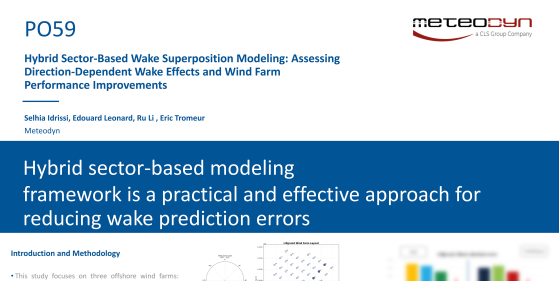
Poster: Hybrid Sector-Based Wake Superposition Modeling: Assessing Direction-Dependent Wake Effects and Wind Farm Performance Improvements
Meteodyn put a hybrid sector-based wake superposition model to the test across three offshore wind farms, Lillgrund, Horns Rev, and Nysted, to see when direction-dependent wake effects call for combining more than one superposition method. Pairing the Linear model for...

Poster: Applying Meso-Micro Coupling in Wind Resource Assessment in Challenging Cases: Validation and Insights
Putting Meso-Micro Coupling to the test in real-world conditions, Meteodyn joined forces with Huaneng Clean Energy Research Institute, Goldwind, Fujian Electric Power Design Institute, and Guohua Green Energy on three of the most technically demanding sites across...
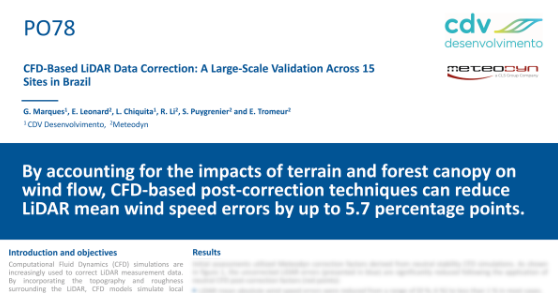
Poster: CFD-Based LiDAR Data Correction: A Large-Scale Validation Across 15 Sites in Brazil
Meteodyn teamed up with Casa Dos Ventos to test its CFD correction approach on real-world LiDAR data. 15 campaigns were conducted across Brazil, spanning everything from flat plains to highly complex terrain. Wind speed errors dropped by as much as 5.7 percentage...
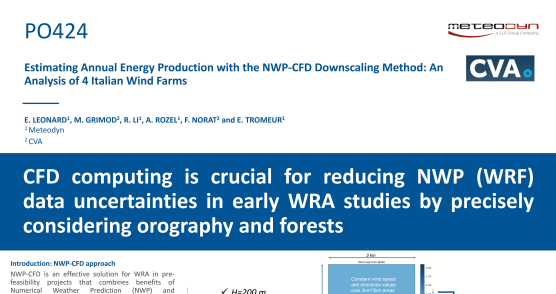
Poster: Estimating Annual Energy Production with the NWP-CFD Downscaling Method: An Analysis of 4 Italian Wind Farms
Wind resource assessment at early project stages relies heavily on mesoscale models like WRF, yet their resolution often falls short when complex terrain and forest cover come into play. This study, conducted in collaboration with CVA, a major Italian wind energy...
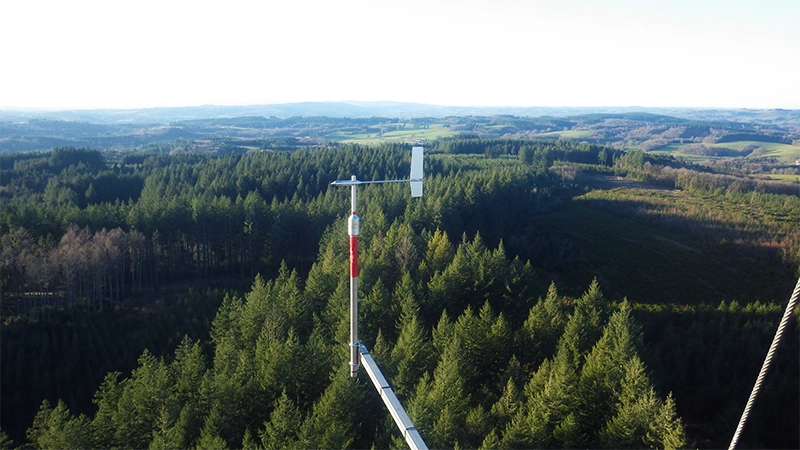
Paper: A Complete CFD Methodology Based on Iterative Model Adjustment to Improve Wind Simulation Accuracy in Highly Dense Forest Area
How Meteodyn achieved 1.1% mean speed error in complex forested terrain, using only standard industrial inputs. A peer-reviewed methodology by Meteodyn & EDF Power Solutions, published in Energies (MDPI)

Replay: Pedestrian wind comfort and safety guidelines with UrbaWind® in Canada
How to ensure pedestrian wind comfort an safety in Canada, in complex urban environments? Urban wind is rarely intuitive. Between building layouts, local acceleration effects and national guidelines, small design choices can significantly impact comfort, or even...
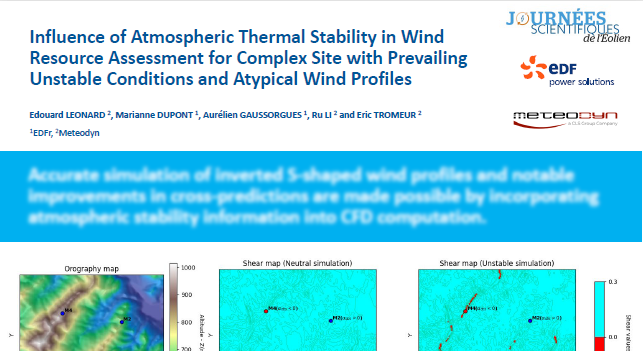
Poster: Influence of Atmospheric Thermal Stability in Wind Resource Assessment for Complex Site with Prevailing Unstable Conditions and Atypical Wind Profiles
Carried out in collaboration with EDF Power Solutions and presented at the french Wind Energy Scientific Days (Journées Scientifiques de l'Éolien) in February 2026, this work demonstrates that, in order to accurately assess a site's wind resources, it is imperative to...
Poster: Influence of atmospheric stability determination methods on wind resource assessment and negative wind shear simulation
Carried out in collaboration with EDF Renouvelables (now EDF Power Solutions) and presented at the WindEurope Technology Workshop in June 2025, this poster demonstrates once again that thermal stability consideration is essential for accurate Wind Resource Assessment,...

Webinar: How to use wind data correctly in wind engineering?
Adjust your wind data for greater accuracy. Join our webinar! In this session, you will discover that small biases in wind data selection can lead to wrong conclusions on pedestrian comfort, facade loads or structural safety, especially in dense and complex urban...