Jul 23, 2026 | Case studies, Onshore and Offshore Wind, Resources, Scientific papers
Meteodyn put a hybrid sector-based wake superposition model to the test across three offshore wind farms, Lillgrund, Horns Rev, and Nysted, to see when direction-dependent wake effects call for combining more than one superposition method. Pairing the Linear model for...
Jul 20, 2026 | Case studies, Meso-micro coupling, Onshore and Offshore Wind, Resources, Scientific papers
Putting Meso-Micro Coupling to the test in real-world conditions, Meteodyn joined forces with Huaneng Clean Energy Research Institute, Goldwind, Fujian Electric Power Design Institute, and Guohua Green Energy on three of the most technically demanding sites across...
Jul 16, 2026 | Case studies, Onshore and Offshore Wind, Resources, Scientific papers
Meteodyn teamed up with Casa Dos Ventos to test its CFD correction approach on real-world LiDAR data. 15 campaigns were conducted across Brazil, spanning everything from flat plains to highly complex terrain. Wind speed errors dropped by as much as 5.7 percentage...
Jun 8, 2026 | Case studies, Onshore and Offshore Wind, Resources, Scientific papers
Wind resource assessment at early project stages relies heavily on mesoscale models like WRF, yet their resolution often falls short when complex terrain and forest cover come into play. This study, conducted in collaboration with CVA, a major Italian wind energy...

Jun 5, 2026 | Buildings and Infrastructure, Climate change, News, Scientific papers
From June 17 to 19, METEODYN team will attend eSim 2026, the Building Performance Simulation Conference organized under the auspices of IBPSA-Canada, at the Université de Sherbrooke in Longueuil Campus, Canada. METEODYN is eager to meet the Canadian building...
May 19, 2026 | Case studies, News, Onshore and Offshore Wind, Scientific papers
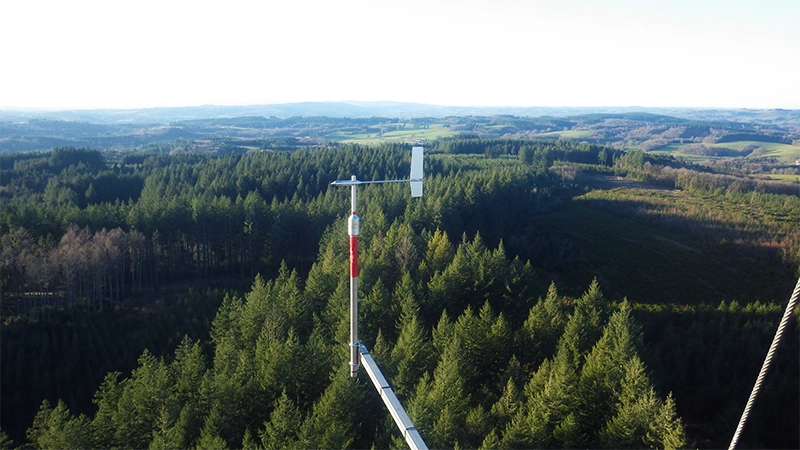
Forested terrain is where wind resource assessment gets complicated. Trees are not passive obstacles: they reshape the wind profile across the entire rotor-swept area, generate turbulence, and produce vertical wind shear patterns that standard roughness models were...
