← Return
Wind Resource Assessment in Forested Terrain: The Iterative Model Adjustment (IMA) Method
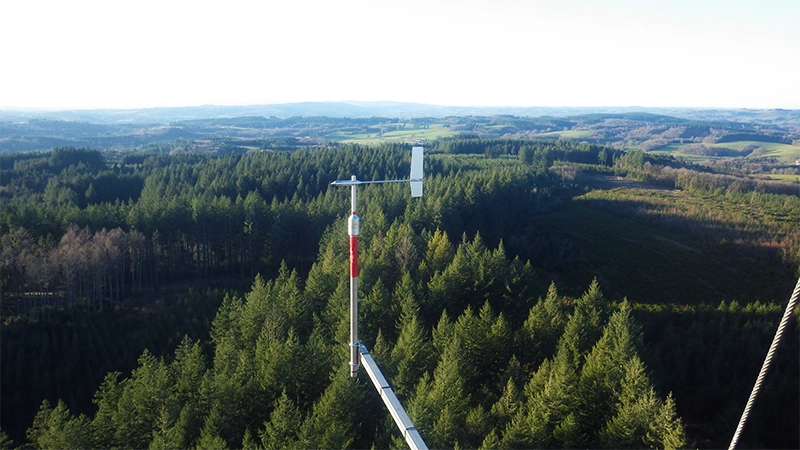
Forested terrain is where wind resource assessment gets complicated. Trees are not passive obstacles: they reshape the wind profile across the entire rotor-swept area, generate turbulence, and produce vertical wind shear patterns that standard roughness models were never designed to capture.
For wind developers working in these environments, the consequences are real. Biased wind profiles lead to unreliable AEP estimates, and unreliable AEP estimates make projects harder to finance.
A methodology, developed by Meteodyn in collaboration with EDF Power Solutions and published in the peer-reviewed journal Energies (MDPI, 2026), addresses this problem with a pragmatic and fully validated approach.
The Core Problem with Forest Wind Modelling
In wind energy, the wind shear profile describes how wind speed varies with height above the ground. It is a critical input for hub-height wind speed estimation, AEP calculations, and turbine load assessment.
In forested terrain, this profile is far more complex than in open land. The tree canopy acts as an aerodynamic drag layer that slows the wind near the surface and distorts the vertical profile across the entire boundary layer. The result is a mismatch between what standard models predict and what instruments actually measure on site.
The challenge grows in complex terrain, where topography and forest cover interact to create flow structures that are genuinely difficult to anticipate without high-fidelity simulation tools.
This is precisely where computational fluid dynamics (CFD) modelling offers a path forward. But accurate CFD simulation of forested terrain requires a proper representation of the forest aerodynamic properties, and those properties vary significantly from one site to another.
The IMA Approach: Site-Specific Calibration Without Additional Data
The methodology proposed by Meteodyn is called Iterative Model Adjustment (IMA). Rather than relying on generic vegetation parameters or requiring expensive additional data collection such as Plant Area Density (PAD) or Leaf Area Density (LAD), the IMA methodology calibrates the forest aerodynamic model directly against wind measurements already collected on site.
The process starts from standard inputs available on any wind project: public roughness and orography maps, and wind measurements from a single meteorological mast. From there, the model is adjusted iteratively until the simulated wind shear matches observed site conditions within a defined accuracy threshold.
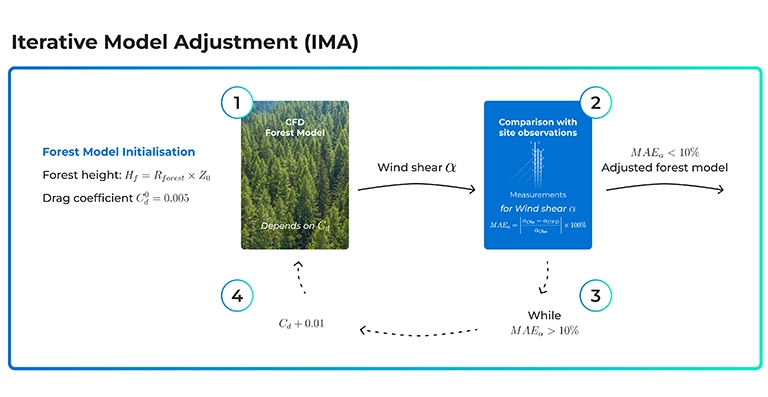
The entire workflow runs within Meteodyn WT, the CFD-based wind resource assessment software used by wind developers and independent engineers on real industrial projects. There is no gap between research methodology and operational practice.
Validated Results Across Six Site Configurations
The IMA methodology was validated over six cross-prediction cases, in three different sites located in Finland, France, and Scotland, covering a range of terrain complexity and forest conditions. The global mean absolute wind speed error across all cases was 1.1%.
This level of accuracy is notable precisely because it was achieved without any premium data inputs. It demonstrates that a well-calibrated CFD framework, fed with standard industrial data, can deliver results that are competitive with measurement-intensive approaches.
The validation methodology, the full set of results, and the detailed analysis of each terrain configuration are available in the published paper.
What This Means in Practice
For wind project developers and resource assessment engineers working in forested or complex terrain, the IMA method offers something genuinely useful: a way to reduce wind resource uncertainty without increasing data acquisition costs or extending project timelines.
Better-calibrated wind profiles mean more defensible AEP estimates. More defensible AEP estimates mean stronger technical files, smoother interactions with lenders, and better-informed investment decisions.
The methodology is also a signal of where the industry is heading. As wind development moves into progressively more complex environments, the ability to model site-specific aerodynamic conditions accurately, using only standard inputs, becomes a meaningful competitive advantage.
About This Publication
This research was conducted by Meteodyn in collaboration with EDF Power Solutions. It was submitted to and accepted by Energies, a peer-reviewed open-access journal published by MDPI, specialising in energy research.
The full paper includes the complete IMA methodology, detailed validation results, and a discussion of the implications for industrial wind resource assessment practice.